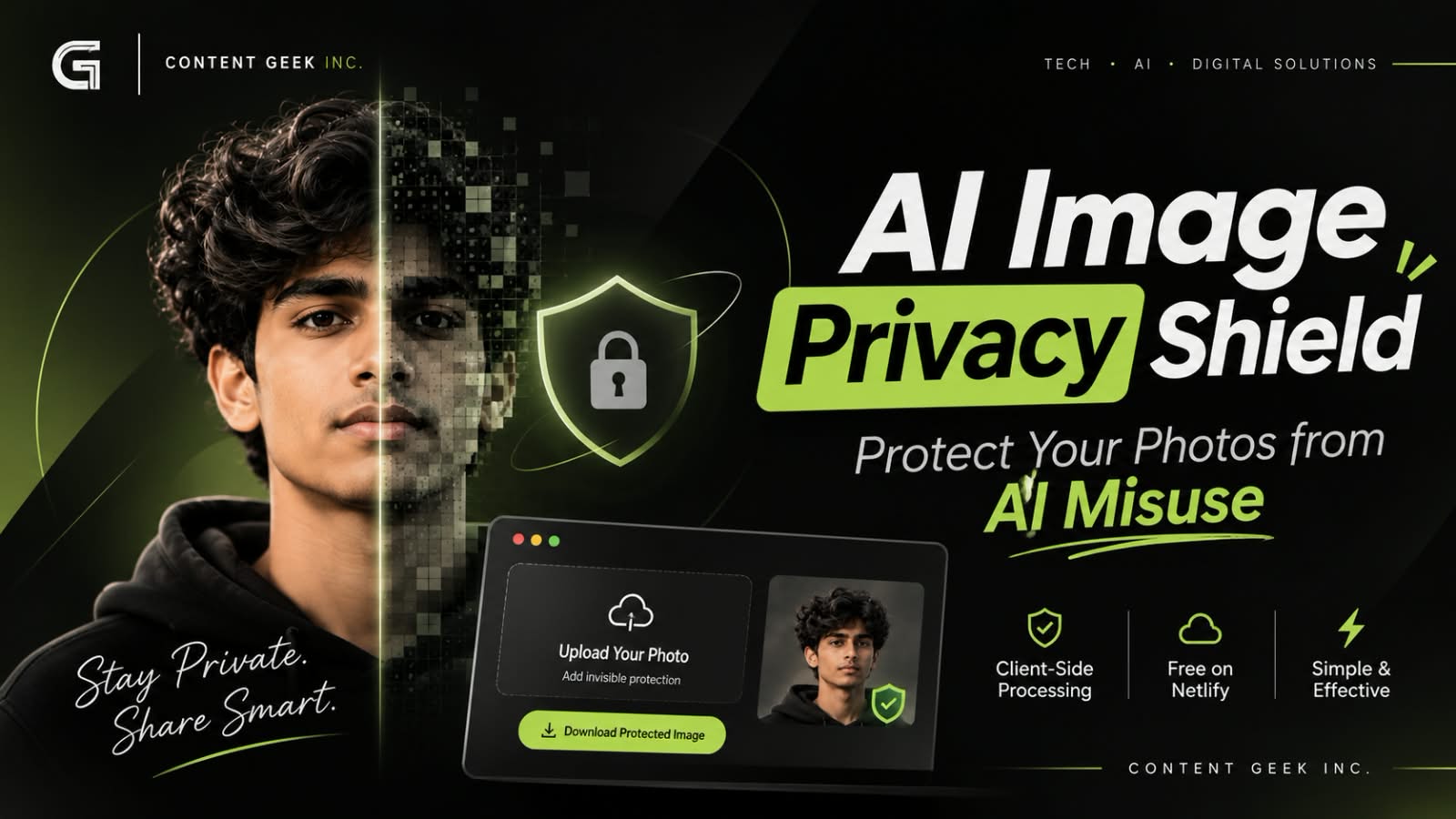
AI Image Privacy: Can You Protect Your Photos from AI Scraping, Facial Recognition and Deepfakes?
Think about how many photographs you have shared online over the years. Your profile pictures, family moments, travel memories, professional headshots, and everyday social media posts are all part of your digital identity. Sharing them might feel harmless, but have you ever wondered what happens to those images after they become publicly available?
With artificial intelligence becoming increasingly powerful, personal photographs are now more valuable than ever. Modern AI systems can analyse facial geometry, recognise subtle visual patterns, generate hyper-realistic synthetic media, and even create manipulated versions of existing photographs.
One promising development in this space is the concept of an AI image privacy shield. This browser-based approach uses subtle, pixel-level modifications to make photographs less useful to automated AI systems while keeping them visually identical to the human eye.
But how does an AI image privacy shield actually work, and can it genuinely help protect your digital identity? Let's explore.
Why Is Image Privacy Becoming a Bigger Concern?
Social media and cloud platforms have made sharing photographs effortless. A single post can reach thousands of people within minutes, and once an image becomes publicly accessible, controlling where it travels or how it is downloaded becomes nearly impossible.
AI-powered image collection and analysis introduce an entirely new layer of risk.
Today, three specific areas demand closer attention:
1. AI Image Scraping
Automated web crawlers and scraping bots continuously collect publicly accessible images from websites, portfolios, and social platforms. Once scraped, individuals and businesses often have little to no visibility into how their photographs are stored, analysed, or repurposed inside large-scale machine-learning datasets.
2. Facial Recognition Technology
Facial recognition systems map distinctive biometric landmarks, such as the distance between the eyes, jawline contours, and facial proportions, to compare or identify individuals.
Although the technology has legitimate security applications, unconsented facial indexing raises major concerns regarding mass surveillance, identity tracking, and personal privacy.
3. Deepfake Generation
Generative AI has significantly lowered the barrier to creating realistic synthetic images and manipulated video media.
Even a handful of clear public portraits can potentially become source material for misleading content, brand impersonation, or unauthorised representations of someone's likeness.
What Is an AI Image Privacy Shield?
An AI image privacy shield is a specialised defensive tool designed to introduce subtle mathematical modifications into digital photographs, interfering with how automated image analysis models read the file.
Traditional photo editing focuses on visible adjustments such as brightness, contrast, colour filters, and cropping. Adversarial image protection takes a fundamentally different approach.
It applies carefully calculated, pixel-level perturbations, often referred to as adversarial noise, that remain virtually invisible to human observers but disrupt how machine-learning algorithms interpret the underlying data.
The objective is not to distort the photograph or hide the subject behind heavy watermarks. Instead, the goal is to preserve the natural visual quality of the portrait while weakening the feature-extraction accuracy of automated scrapers and facial recognition models.
How Does Browser-Based Image Protection Work?
One of the most practical advancements in modern web development is that adversarial image protection can operate entirely within a standard web browser.
Instead of uploading sensitive personal photographs to an external cloud server for processing, a client-side application performs every calculation directly on the user's device.
A typical user workflow follows six simple steps:
1. The user opens the web-based AI image privacy application in their browser.
2. They select or drag-and-drop a photograph directly from their phone or computer.
3. The browser processes the image locally using client-side technologies such as HTML5 Canvas and JavaScript.
4. Subtle pixel-level privacy modifications are applied across key visual regions.
5. The user previews the protected result alongside the original image to verify visual quality.
6. The shielded photograph is downloaded directly to the device, ready for online sharing.
This architecture provides a major privacy advantage: your original, unprotected photograph never leaves your browser or travels across the internet.
Why Client-Side Processing Matters for Digital Privacy
Whenever you upload a personal photograph to a conventional online editing tool, an important security question arises: Where does that file actually go?
Many cloud-based apps transfer uploaded files to remote servers, where images may be cached, logged, or temporarily stored.
A client-side architecture eliminates the need to transmit photographs to an external processing backend.
Key benefits include:
Complete Data Control
Users process photographs directly on their own hardware without handing files over to a third party.
Zero Server Exposure
Because images are never transmitted to an external processing backend, the risk of server-side exposure is reduced.
Reduced Infrastructure Overhead
No expensive GPU backend or database storage is required to handle user uploads.
Fast, Accessible Performance
Users can process photos from any modern desktop or mobile browser without installing heavy software.
Of course, responsible developers must also account for local browser storage, third-party scripts, and analytics trackers. A genuinely privacy-first web application should remain transparent about its code and avoid hidden data collection.
Building a Privacy-Focused Image Protection Tool
Developing a browser-based image privacy application does not require complex enterprise infrastructure.
Developers can build a fast, lightweight web application using core front-end technologies such as HTML5, CSS3, and modern JavaScript.
The primary objective is to make privacy accessible to everyone—not just cybersecurity specialists.
Users should not need to understand machine learning or pixel matrices to safeguard their portraits. Intuitive upload zones, clear visual previews, and transparent privacy explanations make a tremendous difference in user adoption.
Prioritising clean, user-centric functionality is also an important consideration when modernising existing digital platforms.
Can You Host It for Free on Netlify?
Yes. Because a client-side image privacy shield executes all image processing inside the visitor's browser, the application itself consists entirely of static files (HTML, CSS, and JavaScript).
This means it can be deployed as a static web application on modern hosting platforms like Netlify without requiring a dedicated backend server.
A standard deployment workflow involves organising the static project repository, connecting it to Netlify through GitHub or direct drag-and-drop deployment, and serving the application over secure HTTPS via a global Content Delivery Network (CDN).
This enables independent developers, students, and digital studios to launch privacy-focused utilities without paying for dedicated backend servers, although standard platform bandwidth limits still apply as traffic scales.
What Are the Limitations of Adversarial Image Protection?
While adversarial image shields are a clever defensive layer, it is important to approach the technology with realistic expectations.
Pixel-level modifications do not provide an impenetrable guarantee against all forms of AI scraping, facial recognition, or deepfake synthesis.
Different machine-learning architectures respond differently to adversarial noise. Furthermore, major social media platforms routinely compress, resize, and strip metadata from uploaded photographs, which can dilute subtle pixel modifications.
As AI systems continue to evolve, newer models are also being trained to remain resilient against standard perturbation techniques.
For this reason, an AI image privacy shield should be treated as one valuable layer within a broader digital hygiene strategy—alongside tightening social media privacy settings, limiting public high-resolution uploads, and staying mindful of where personal photographs are published.
The Future of Personal Image Privacy
As synthetic media becomes virtually indistinguishable from real photography, conversations around digital ownership, biometric consent, and online visibility will only intensify.
Individuals and businesses increasingly need practical tools that help them control how their visual assets are indexed, accessed, and used by AI systems.
Privacy-preserving web technologies, combining client-side browser processing with adversarial image defence, represent a meaningful step toward returning control to everyday internet users.
Frequently Asked Questions (FAQs)
Does an AI image privacy shield visibly change how my photo looks?
No. Well-designed adversarial image shields apply micro-level pixel adjustments that remain virtually imperceptible to the human eye, preserving the natural look of your portrait while attempting to disrupt automated pattern extraction.
Are my photos uploaded to a server when using a client-side privacy tool?
No. A genuinely client-side web application processes your image locally inside your device's web browser using HTML5 Canvas and JavaScript. Your original photograph is not transmitted to or stored on an external processing server.
Can social media compression affect image privacy shields?
Yes. Heavy image compression or resizing on platforms like Instagram, Facebook, or X can sometimes reduce the effectiveness of subtle pixel-level modifications. This is why image shields work best alongside strong account privacy settings.
Conclusion: Taking Control of Your Digital Identity
Your photographs are far more than simple digital files—they represent your memories, professional reputation, and personal identity.
As artificial intelligence continues to transform how online media is collected, analysed, and generated, proactive image privacy is becoming essential.
Browser-based AI image privacy shields offer an accessible, zero-upload way to add defensive protection to your photographs before sharing them online. Combined with mindful sharing habits and strong platform privacy settings, they empower you to share smarter in an AI-driven world.
At Content Geek Inc., we believe technology should make everyday digital experiences more useful, accessible, and secure.
The future of AI should not only be about what machines can create, but also about giving people and businesses greater control over their digital identities.
Looking to build secure, high-performing digital solutions or elevate your brand's online presence?
Contact Content Geek Inc. today to get started.